Texas A&M In-State Tuition: Complete 2026 Guide for Out-of-State Families
Out-of-state students pay $40,000+ annually at Texas A&M—but qualifying for in-state tuition starting sophomore year can save your family over $85,000 across the final three years. This guide reveals the pathways out-of-state families use to potentially secure Texas residency and access the $11,500 in-state rate. Understanding the requirements to instate tuition requirements for Texas is crucial for families looking to ease the financial burden of higher education. By meeting the criteria, out-of-state students can take advantage of significant savings that make Texas universities more accessible. Navigating the application process can seem daunting, but with careful planning, many families have successfully transitioned to in-state status.
The Financial Impact: Why Out-of-State Families Pursue Texas Residency
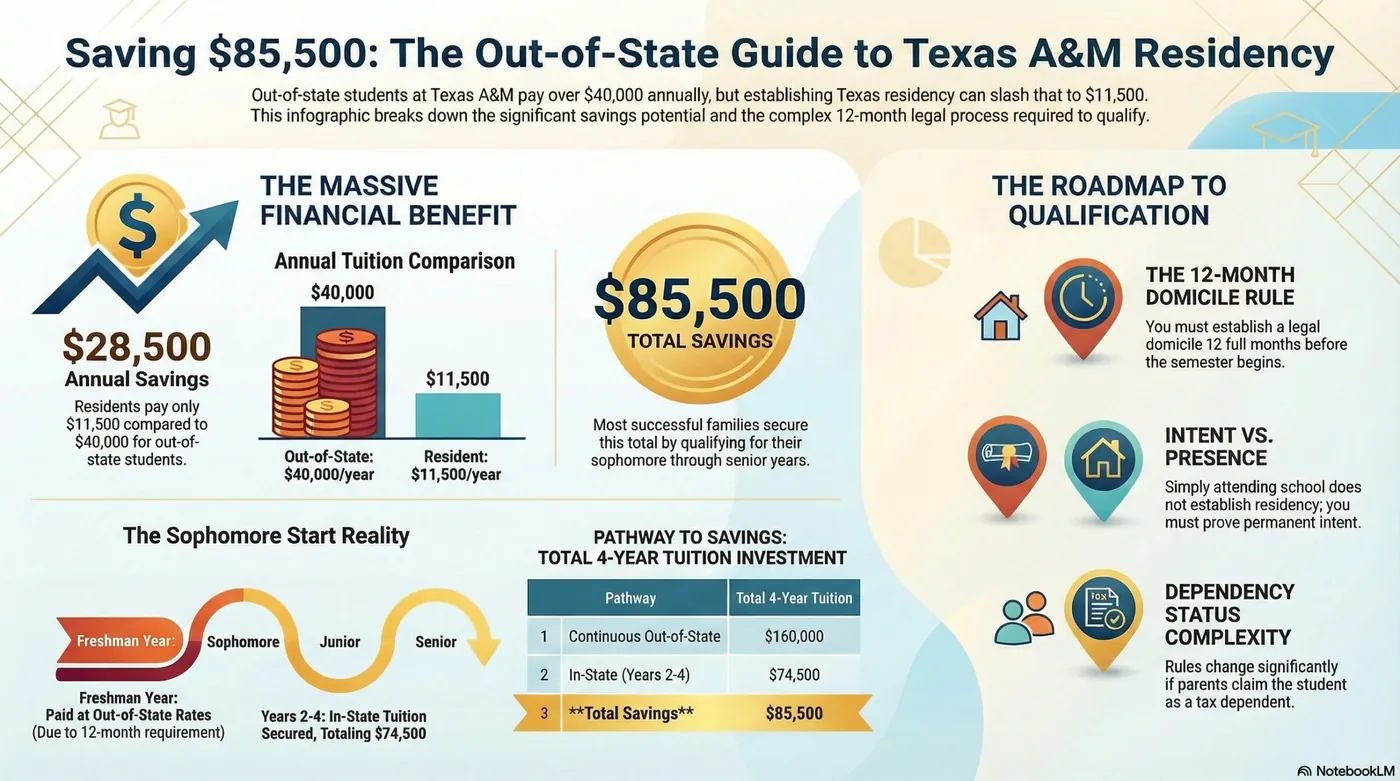
The cost difference between out-of-state and in-state tuition at Texas A&M represents one of the largest financial gaps among public universities. For 2026-2027, out-of-state students pay approximately $40,000 in tuition and fees compared to just $11,500 for Texas residents—a staggering difference of $28,500 per year.
Understanding the Realistic Savings Timeline
Because Texas requires 12 months of domicile establishment before enrollment, most out-of-state students cannot qualify for in-state rates until their sophomore year at the earliest. This means the realistic savings window covers three years (sophomore, junior, and senior year)—not the full four-year program. Freshman year is typically paid at the out-of-state rate of $40,000.
Total Three-Year Savings by Qualifying for Sophomore Year
Based on 2026-2027 tuition rates; freshman year paid at out-of-state rates
The Complete Four-Year Cost Picture
Understanding the total financial impact requires examining the complete four-year investment. An out-of-state student paying full rates for all four years faces approximately $160,000 in tuition costs. A student who qualifies for in-state rates starting sophomore year pays $40,000 freshman year plus $34,500 for the remaining three years—totaling $74,500. The difference represents $85,500 in savings, making residency qualification one of the most significant financial decisions families can make.
⚠️ 5 Critical Mistakes Out-of-State Families Make
Families attempting to establish Texas residency without proper guidance frequently encounter expensive setbacks. Understanding these pitfalls is essential:
- Believing enrollment establishes residency: Attending Texas A&M does not create the legal domicile Texas requires—the state examines specific documented actions demonstrating permanent intent
- Underestimating the 12-month timeline: Texas requires domicile 12 full months before the semester begins, and the timing rules are more nuanced than many families realize
- Assuming dependents can qualify independently: If parents claim you as dependent, residency classification becomes significantly more complex with specific requirements many families overlook
- Missing critical documentation timing: Obtaining the right documentation in the right sequence at the right time is essential—mistakes in documentation timing frequently lead to denial
- Attempting mid-enrollment conversion: Texas prohibits changing from out-of-state to in-state while continuously enrolled, and there are limited exceptions that require careful navigation
“The most expensive mistake is assuming the process is straightforward and attempting it without understanding the complex interplay of timing, documentation sequence, and Texas’s specific interpretation of ‘permanent intent.’ Each family’s situation involves unique variables that determine their optimal pathway.”
— Texas Residency Classification AdvisorWhy Professional Guidance Matters: With $85,500+ at stake, families who work with experienced advisors who understand the nuances of Texas residency law navigate the process more successfully and avoid errors costing $28,500+ annually in unnecessary tuition charges.
Understanding Texas Domicile Requirements
Texas distinguishes between physical presence and legal domicile. You must physically reside in Texas for 12 consecutive months while demonstrating through objective evidence that Texas is your permanent home—not temporary educational residence. However, what constitutes “sufficient evidence” varies based on individual circumstances. According to Texas A&M University System residency guidelines, the evaluation process considers numerous factors specific to each applicant’s situation.
The Multi-Factor Evaluation Process
Texas uses a holistic evaluation approach examining numerous factors to determine domicile. The Texas A&M Admissions Office weighs various categories of evidence, and the strength requirements differ depending on whether you’re dependent or independent, your age, your family’s situation, and other individual variables. This is not a simple checkbox process.
Evidence Categories Texas Evaluates
While Texas publishes general documentation categories, the specific combination, timing, and strength of evidence needed varies significantly by circumstance. Categories include government-issued identification, property and financial ties, civic integration, employment history, residential documentation, and family situation—but how these pieces fit together differs for each applicant’s unique profile.
Dependency Status Complexity
Dependent students (claimed on parents’ taxes) face particular complexity. The interaction between tax dependency, financial independence, and residency classification involves numerous variables and exceptions that aren’t immediately obvious from published guidelines. Many families discover too late that their assumptions about dependency and residency were incorrect, resulting in costly denial.
Some families explore pathways involving financial independence, but this requires understanding complex requirements around income levels, support percentages, timing considerations, and documentation sequencing. The intersection of dependency status and residency qualification represents one of the most intricate areas where professional guidance proves especially valuable.
Qualification Pathways for Out-of-State Families
Out-of-state families pursue several distinct pathways to secure Texas residency, each with its own complexity, documentation requirements, and strategic considerations. Success depends heavily on choosing the right pathway for your specific family situation.
Full Family Relocation
The most common approach involves the entire family relocating to Texas with genuine permanent intent. However, what constitutes “permanent intent” in the eyes of Texas residency evaluators involves demonstrating commitment through specific actions taken in specific sequences. Families with employment-driven moves generally find stronger footing, but there are numerous subtleties around timing, documentation order, and demonstrating that the move isn’t primarily for educational cost savings.
Independent Student Pathways
Students attempting to establish independent Texas domicile face particular scrutiny around financial independence and intent. Texas applies specific tests to determine whether a student has genuinely established separate residency or is simply attempting to circumvent out-of-state classification while remaining financially connected to out-of-state parents. The requirements involve careful coordination of financial, residential, and civic integration factors.
Gap Year and Community College Strategies
Some families successfully use gap years or community college pathways to establish residency, but these strategies involve careful planning around the activities undertaken during that period, how financial support is structured, and how permanent intent is demonstrated. The devil is in the details—two families pursuing similar pathways may achieve different outcomes based on subtle differences in how they structure and document the process.
Understanding Which Pathway Fits Your Situation
Choosing the optimal pathway requires evaluating your family’s specific circumstances: current residence state, student’s age and academic timeline, parents’ employment flexibility, financial situation, and numerous other variables. What works for one family may not work for another, and attempting the wrong pathway for your situation wastes time and money. Many families benefit from professional evaluation to identify their highest-probability pathway before committing to a course of action.
🏆 What Distinguishes Successful Qualification Attempts
Families who successfully navigate Texas residency qualification demonstrate these critical patterns:
Strategic Early Planning
Beginning evaluation 18-24 months in advance allows proper pathway selection and timing optimization
Documentation Sequencing
Understanding which documents to obtain in which order creates compelling evidence chains
Genuine Intent Demonstration
Knowing how to demonstrate authentic permanent relocation through specific, timed actions
Situation-Specific Strategy
Recognizing that cookie-cutter approaches fail—successful families customize their approach
Proactive Verification
Understanding when and how to engage with the Residency Office to confirm approach validity
Risk Assessment
Evaluating probability of success before committing resources and having contingency plans
The families who successfully qualify typically work with advisors who understand not just the published rules, but how Texas actually evaluates and interprets evidence in practice—knowledge that comes from extensive experience navigating the specific nuances of Texas A&M’s Residency Office.
Critical Timeline Planning
Successful residency qualification requires precise timing coordination, but the timeline complexity goes beyond simply counting back 12 months. The sequence and timing of specific actions within that 12-month period significantly impacts evaluation outcomes. The Texas A&M Student Business Services office provides official guidelines, though individual circumstances require careful interpretation.
Understanding the 12-Month Requirement
While Texas requires 12 months of domicile before enrollment, what counts as “establishment of domicile” versus simply “being present in Texas” involves specific criteria. Actions taken on day 1 carry different weight than actions taken on day 300, and the sequence matters. Many families learn too late that they’ve satisfied the time requirement without properly establishing domicile during that time.
| Target In-State Start | Timeline Complexity | Planning Horizon | Potential Savings |
|---|---|---|---|
| Sophomore Fall 2027 | Moderate | 18-20 months | $85,500 (3 years) |
| Freshman Fall 2027 | Higher | 22-24 months | $114,000 (4 years) |
| Junior Fall 2027 | Lower | 15-18 months | $57,000 (2 years) |
Complexity varies by family situation; planning horizons assume time for strategy development and contingency handling
Common Timeline Miscalculations
Families frequently miscalculate by focusing solely on physical presence duration without understanding that domicile establishment involves specific action timing requirements. For example, when certain documents are obtained relative to your Texas arrival date matters significantly. Getting a Texas driver’s license three months after moving has different implications than getting it within the first week, even if both scenarios satisfy the 12-month presence requirement.
Timeline Strategy Considerations
- Begin strategic planning 18-24 months before target enrollment, not 12 months
- Understand that documentation timing within the 12-month period affects evaluation strength
- Recognize that certain actions should occur in specific sequences for optimal evidence
- Plan buffer time for unexpected complications or documentation delays
- Consider that family situations may require longer or shorter preparation timelines
The families who successfully navigate timeline requirements typically work with advisors who can map out their specific situation and identify the critical timing milestones unique to their pathway, rather than assuming a generic timeline applies to everyone. For official Texas residency regulations, consult the Texas Higher Education Coordinating Board residency rules.
Who Successfully Qualifies
Permanent Relocators
Families with genuine permanent relocation reasons (employment, family, lifestyle) who properly document and sequence their Texas integration.
Career-Driven Movers
Families where parent employment provides authentic Texas relocation imperative and strong permanent intent foundation.
Strategic Gap Year Students
Students who properly structure gap year activities to demonstrate independent Texas domicile with appropriate financial separation.
Transfer Pathway Planners
Families who use community college strategically while properly establishing and documenting Texas residency during that period.
Frequently Asked Questions
Yes, but qualification requires navigating complex requirements around establishing Texas domicile 12 consecutive months before enrollment. Success depends heavily on your specific family situation, the pathway you choose, how you sequence and document your Texas integration, and numerous other variables. Many families can potentially qualify, but the process requires careful planning and execution tailored to individual circumstances.
The annual savings is $28,500 (the difference between $40,000 out-of-state and $11,500 in-state tuition). Realistic total savings are $85,500 over three years if qualifying for sophomore year, or $114,000 over four years if qualifying from freshman year via properly structured gap year. These substantial savings make residency qualification worth serious consideration and professional guidance for families who can realistically pursue it.
Texas generally prohibits mid-enrollment conversion, though there are specific exception scenarios that some families may qualify for depending on their circumstances. The rules around continuous enrollment and reclassification are complex with nuances that aren’t obvious from published guidelines. This is one area where understanding the specific exceptions and how they might apply to your situation is particularly valuable—a mistake costs $28,500 annually.
Denial typically results from insufficient demonstration of permanent intent, documentation timing issues, failure to satisfy specific requirements for dependent versus independent students, gaps in evidence chains, or attempting pathways that don’t fit the family’s actual situation. Many denials occur because families don’t understand what Texas is actually evaluating and why certain evidence carries more weight than other evidence in their specific circumstances.
With $85,500-114,000 in potential savings, residency qualification is financially significant for families who can realistically achieve it. However, “can realistically achieve it” depends on numerous factors unique to each family. The decision requires honest evaluation of your specific situation, understanding which pathways are viable for you, and assessing probability of success. Many families benefit from professional assessment before committing time and resources to determine if pursuit makes strategic sense for their circumstances.
Determining qualification feasibility requires evaluating your family’s specific variables: current state of residence, student’s dependency status and age, parents’ employment situation and relocation flexibility, timeline constraints, financial structure, and how these factors interact with Texas’s evaluation criteria. Because each family’s situation differs, what’s realistic for one family may not be for another. Professional evaluation helps identify your probability of success and optimal pathway before you invest significant time and resources.
Given $85,500+ in financial stakes, many families find that professional guidance provides significant value. Advisors experienced in Texas residency qualification understand not just the published requirements but how Texas A&M’s Residency Office actually evaluates applications in practice—including the nuances, exceptions, and situation-specific strategies that aren’t obvious from general guidelines. This inside knowledge helps families avoid costly mistakes and optimize their approach for their unique circumstances. The investment in guidance is typically modest compared to the cost of qualification errors or denied applications.
